The Turning Point

In the labyrinth of the corridors of the Ministry of Information—a name that conjures up illusions of Orwell’s 1984—I could not quite believe that it was actually happening. Something I had aspired to since I began this trip…

The Turning Point

In the labyrinth of the corridors of the Ministry of Information—a name that conjures up illusions of Orwell’s 1984—I could not quite believe that it was actually happening. Something I had aspired to since I began this trip was suddenly starting to take form, to become real.

I sat in a deep, leather armchair in one of the offices, filled out a form and handed over my passport with two passport photographs, expecting this dream to crumble away with refusal.

A little over a year ago, I was laying in a refuge on the slopes of Mount Toubkal*. For the past eight months, I have been traveling through the Middle East, learning, practicing, meeting people who are doing what I want to do, and dreaming.

Then, one hot afternoon in Khartoum, I received an e-mail asking me if I would work on an assignment for a German magazine as a photographer. Two days later, I am with the bureau chief for AFP as he introduces me to the official who will decide whether I can step into this world.

As the question was leaving my mouth about whether my tourist visa would bar entry to the world of journalism, I checked myself. It is better to not ask questions to which you do not want to hear the answer.

Twenty minutes later, I had a press-card in my hand, and two days later I was in an Ethiopian restaurant, meeting the German journalist with whom I would be working.

I spent the best part of a week with her and some Eritrean refugees, documenting the story of Zekarias, who had fled his homeland eight years previously. Khartoum was part of his clandestine route to Europe, where he now lives. He had not seen his mother since he left, and now, back in the hot, dusty streets of Khartoum, he would be reunited with her.

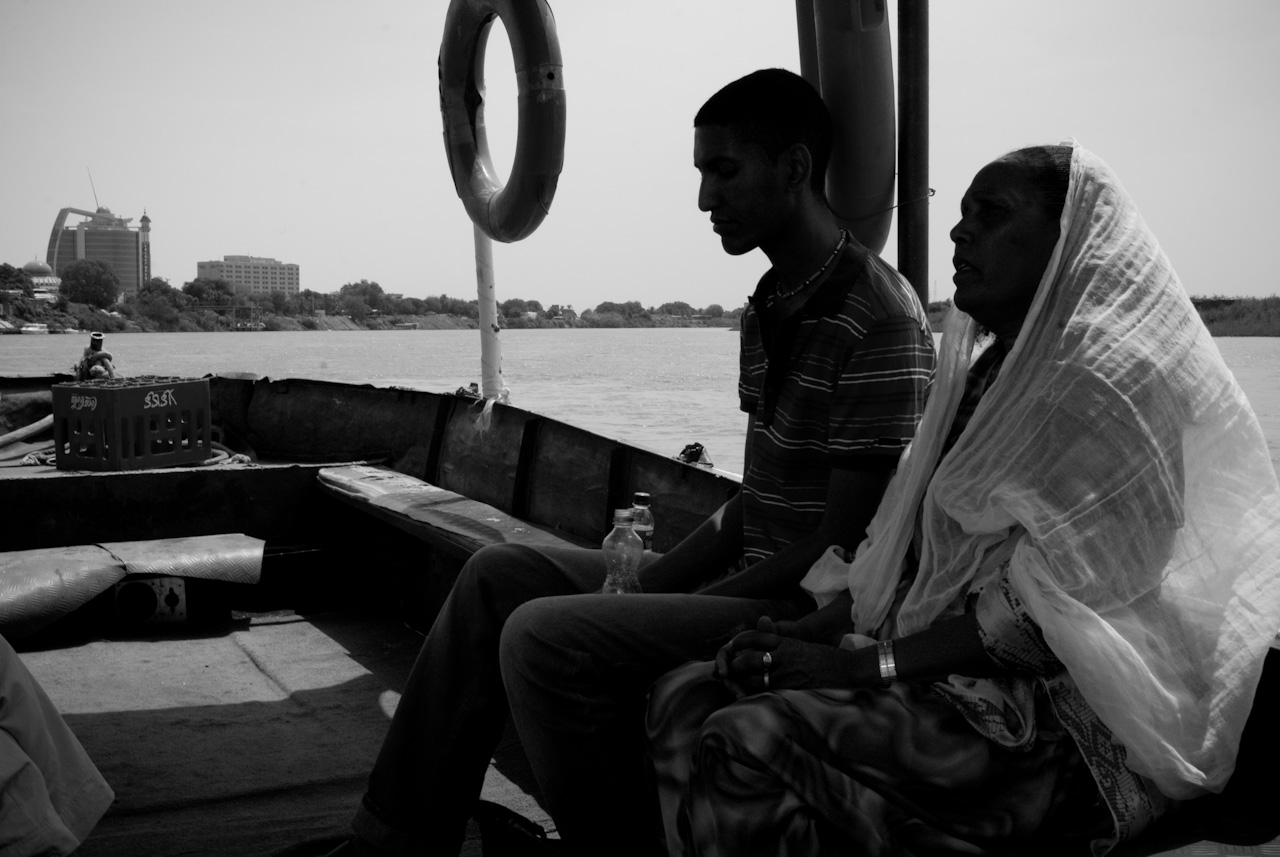
On the days when I was shooting, I would wake up clogged by anticipation and fear. Was I capable of this? - the feeling of being out of my depth ever-present. But this was the turning point, the first step towards realising this ambition. Sat in a boat on the Blue Nile, touring Tuti Island, I knew that this was the path I wanted to take.

And so it starts…

» Read more about the story of Zekarias in my portfolio.

À la mode

Sudan and fashion are not usually two words that go together. At a recent competition for African designers, several Sudanese students entered, but were not selected. The new director of the Goethe Institut heard about this, and wanted to…

À la mode

Sudan and fashion are not usually two words that go together. At a recent competition for African designers, several Sudanese students entered, but were not selected. The new director of the Goethe Institut heard about this, and wanted to know why. Surely it could not only be a question of talent if not one single designer was chosen?

It turns out that fashion students here know how to design, but not to present their work. And so another workshop was born, focusing on portfolios, CVs and marketing oneself. A spin-off for this was a night show-casing their work, where a small collection of people in the industry were invited. “You do not need to search abroad to find product and talent”, being the message.

As Miss South Sudan took to the catwalk, marking the culmination of the night, the organisers were checking their watches. The previous night, another fashion show—virtually unheard of in Khartoum—had been raided by the police and people arrested for indecency. The morning’s papers had run the story and reactions from Sudanese acquaintances ranged from understanding of why they were arrested to indignation of the cultural state of the country. “I just want to get out of this place”, one friend said in exasperation.

Freedoms do seem to be opening up, although at times the police flex their muscle and restrictions close in. With the Southern Sudan referendum on the horizon, certain liberties would make unity much more attractive, a goal that the governments of both North- and South-Sudan are at least nominally committed to. Should independence occur, what will become of these events and will the country tighten further, without its Southern influence?

Tonight, at least, the police stayed away.

Fête de la Musique

It was during my three years living in Paris that I was first exposed to the Fête de la musique, an annual event that fills the air in the France’s towns and villages with music. Brass bands play on street corners a few met…

Fête de la Musique

It was during my three years living in Paris that I was first exposed to the Fête de la musique, an annual event that fills the air in the France’s towns and villages with music. Brass bands play on street corners a few metres away from rappers performing outside restaurants. Inside small bars, guitarists entertain. Cafés, parks and monuments are all full of performances on the northern hemisphere’s longest day of the year.

If you told me one year ago today, listening to bands play in Paris, that in twelve months time I would be reliving a slice of this in Sudan’s capital, still fêting la musique, it would have been a struggle to believe.

But the francophones of Centre Culturel Français in Khartoum did good - the roof of the centre was filled by a mix of Sudanese & expatriates. A mix of bands & students took to the stage, breaking many stereotypes of the country. The music was a mix of Western classics, improvised slam and Sudanese songs that brought the assembled crowd to their feet. A solitary fan provided little respite from the unrelenting heat of the day’s sun, blowing air in the direction of the French ambassador and his wife.

Ça va ou quoi ? shouted one rather vocal rapper. Ça va bien.

And they say the English drink tea

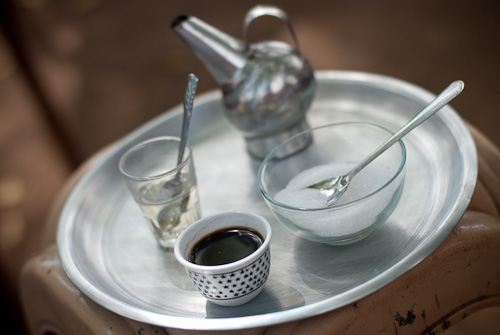
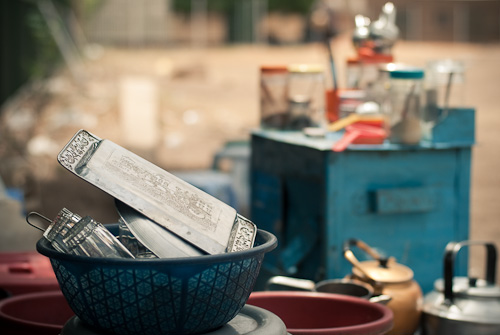
On plastic or string-woven stools by the side of the dusty road, a group of men can inevitably be found, engaged in conversation. At the centre of the circle they circumscribe, a painted metal cabinet sits, an array of jars of spices lined along its top, the smoke from burning sandalwood emanating from smouldering coals. Seated behind this one finds the Tea Lady, an essential part of Sudanese street culture. Beside her, charcoals boil water in enormous kettles, and coffee pots made out of old tins of ghee—or even aircraft oil—bubble away.

As a visitor to Sudan, these ladies are one of the first things that one notices, a quaint constant found in every town. They seem to keep the country going, blood-sugar levels sustained by sweet, thick shai (tea) or spiced jebbana (coffee) in scorching heat that kills the appetite.

In the early morning, they serve doughnuts from iron pans filled with oil, keeping hunger at bay until the eleven o’clock fittur (breakfast). Come late afternoon, the drink of choice is shai bil-laban, tea with milk powder. Their incense is burning into the night, and in restaurants, it is a tea-lady that provides post-meal coffee, franchised into the corner of the establishment.

Yet a rumble of discontent rolled through government not so long ago. A female minister made a move to diminish the tea-ladies from the streets of Khartoum, claiming that they represented poverty, gender issues and they are not a civilised feature of the country, stimulating prostitution and drug use. Luckily, a group of intellectuals rallied behind their cause with a counter-campaign, saying that they formed a vital part of Sudanese culture. A student at the Documentary Film Workshop at the Goethe Institut had wanted to make a film about them, but was denied permission by the relevant ministry. “It was the perfect story”, she said.

These ladies, many of who are migrants from Ethiopia, do come from the lower end of the economic scale, struggling to make a living. But they form a great hub of society, a social lynchpin. Under the great bridge to Tuti Island, the groups of people sat beside the Nile are all supping tea. On the shores of the island, where Khartoum “heads to the beach” come weekend, it is the tea-lady that provides the only refreshment. Outside a major hospital in Khartoum 2, visiting relatives sit waiting, engaged in discussion around these stands. On the street in front of the French Cultural Centre, staff and students alike sit in the late afternoon, the tea-lady serving with her notions of French. And in a delicious fish-restaurant in al-Amarat, it is an Ethiopian tea-lady that provides the after-meal drinks.

Mine will be a shai bil-nana, shukran.

» See more photos: Tea Ladies.

Bring Back Film

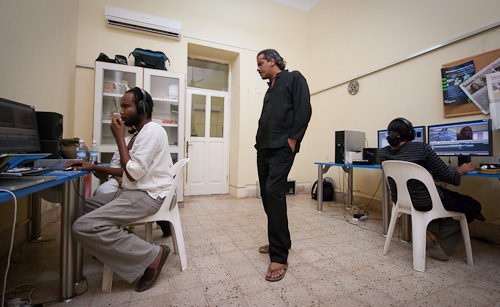
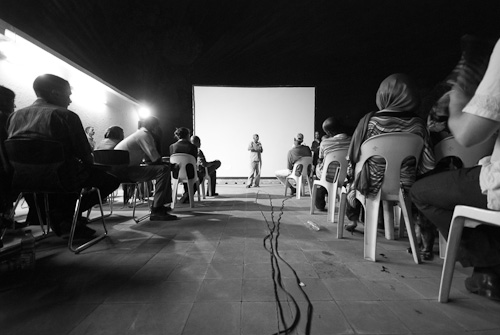
An overhead fan spins overhead, cutting through the flickering artificial light as three students are focused on the flat-screen monitors before them, feverishly working. Three new, Sony video-cameras sit on a table beside one of the workstations. They form part of a group of aspiring Sudanese film-makers participating in a documentary film-making workshop organised by the Goethe Institut here in Khartoum. In four hours time, the fruits of their past five months’ labour would be presented on the roof of the building, but for the time being, the subtitles to these films are being hurriedly added for the benefit of the international audience who will be present.

Sudan has produced some reputed film makers such as Hussein Shariffe and Gadella Gubara—both of whom now dead—but there have not really been any films made in the past twenty years. Aspiring young Sudanese film-makers study abroad—in the UK, the United States—and produce their films overseas.

Talal Afifi, the project coordinator for the workshop, explains that this is because there is no film industry in place, unlike Egypt, Sudan’s northern neighbour, who’s cinema is renown throughout the Arab world. “There are no actors, no producers and no money for art. If you have a film, there is nowhere to screen it.” In the whole of Khartoum, there is one cinema.

“The relationship between the community and art is not bridged”, he explains, saying that most people regard the arts simply as entertainment for people who have money and want to enjoy themselves. “The culture of going to the cinema ended twenty-five years ago, so this generation has no idea of what is the cinema environment.”

But this new generation, growing up, is fresh with new ideas, aspiration and “a deep love for art and life”. For the workshop, twenty-one were selected to participate coming from varied backgrounds — the arts to management — to learn about the whole process of producing a film, from conception to cinematography, sound, lighting, directing and editing. What was important during the selection process was not their experience, but their love for the medium. “They were all obsessed with the idea of cinema and film-making” says Talal.

What he found interesting was the interest expressed by girls, with the majority of CVs sent coming from female candidates; from the six films produced during the workshop, five were by girls.

This is a country where everything is done by men; in the street, we only see men. So this is a real thing… Girls in Africa are more in touch with their inner identity.

Talal Afifi — project coordinator

In the scope of the workshop, students were free to develop a topic of their choice, although the constraints of working in Sudan limited that somewhat. Areej Zarrouq, whose film Orange Tint revolves around a typical girls’ day as they talk about life in Sudan, touches on gender issues, politics, problems they face and social interaction. But her original idea for the film was to focus on the tea-ladies of Khartoum, an idea she was forced to abandon due to problems getting permission from the Sudanese authorities to film. “I thought it was the perfect story” she says, but the authorities told her that she was not supposed to come near them, claiming they represent gender issues, poverty and inferiority. From my own experience of photographing in Sudan, one is obliged to sign a permit stating that photography of any “defaming subjects” is forbidden.

The final six films projected a broad spectrum of life and interest in Sudan. From Areej’s film of middle-class girls discussing life, to The Rabbaba Man - a working-class artist selling the stringed instruments he crafted whilst singing songs in impoverished neighbourhoods. The final film of the night was Diversity which followed a group of Sudanese artists as they promoted the idea of a unified Sudan - a subject evidently pertinent with the audience who will possibly see their country divided with the referendum in January 2011.

Talal talks about this subject, hoping for a unified Sudan post-referendum. Sudan is a vast and diverse country, and having this mixture makes everything more rich, enhancing art and culture within the country. “You are losing the scent of your perfume” he says.

Following the workshop, there is hope that some of the films will be accepted for international film festivals, with submissions to Cairo and East Africa. Formally, it is now finished, but the Goethe Institut will continue to support these—and other—artists, hosting the editing suite and filming equipment.

What we need here as artists in Sudan is the support of artists all over the world. Exchanging experience, knowledge, techniques and ideas… If [international] artists come here, they can find another kind of life that can give them more inspiration.