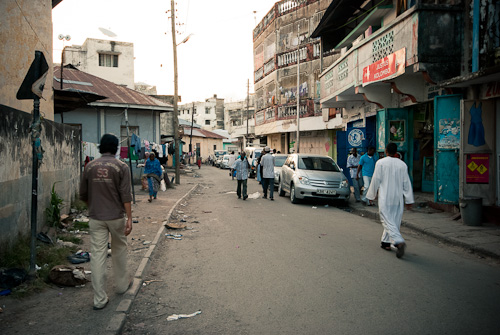
Old Town Mombasa

Whilst Congowea market has a distinctly African flavour, Mombasa’s old-town is something different. There is a much more arab flavour to East Africa’s port, with the Swahili culture adding a very nice twist, particularly whilst enjoying a coffee in a little café tucked away in the back-streets.

Walking the streets at dusk during Ramadan, people prepare to break the day’s fast with their Iftar meal. An echo of France—a painted wall advertising “Épices + Thé + Café”—reminds me of last year during Ramadan, when I was walking the outskirts of Paris in a very Maghreb neighbourhood, en route to the climbing wall in Pantin. Things have changed.

Mombasa Markets

African markets are a far cry from the Middle Eastern souqs I have been accustomed to. They’re so, um, green. Sukumawiki a go-go.

Mombasa

It’s been nearly five months since I last saw the sea up in Alexandria, the Mediterranean joining the Middle East to Europe. Mombasa is the gateway to East Africa, from the Arab peninsula, India and the Far East; the Indian Ocean lapp…

Mombasa

It’s been nearly five months since I last saw the sea up in Alexandria, the Mediterranean joining the Middle East to Europe. Mombasa is the gateway to East Africa, from the Arab peninsula, India and the Far East; the Indian Ocean lapping the Swahili coast, which itself is a fusion of Africa, Arab traders and India.

South of Mombasa, the Likona ferry tirelessly carries passengers from the island to the mainland. Crossing the bridge to the north, beaches form the shoreline, where swathes of Kenyans bathe in the ocean. I was there with a Kenyan friend, who was keen to go in the sea, but joined the masses around us in venturing out only with the aid of a “floater” - a giant black rubber ring. Many of these people, living right on the coast, cannot swim. I join a costaud Kenyan guy in trying to teach them, struggling to remember how I learned as a child.

The Overnighter to Mombasa

Pulling out of Nairobi night had already descended and so as the train skirted around the Nairobi National Park, we, the passengers, were oblivious to it as we supped on bottles of Tusker.

Woken at dawn to the sound of t…

The Overnighter to Mombasa

Pulling out of Nairobi night had already descended and so as the train skirted around the Nairobi National Park, we, the passengers, were oblivious to it as we supped on bottles of Tusker.

Woken at dawn to the sound of the coach-master ringing the breakfast bell, acacia trees and the occasional baobab tree floated past the window in the savannah of the Tsavo National Park, small huts occasionally dotting the horizon.

As we approached the Swahili coast, people started to appear by the sides of the tracks, waving at the train that passes through their lands every other day. Passengers were leaning out of the windows watching the landscape unfold. The waves then turned to up-turned hands, asking for money — ”twenty shillings” — or food, as the train slowly crept past villages. Children running alongside the carriages, chasing the train, or their hopes of a little subsistence.

Arriving into Mombasa, the humidity hits, as men were eager to ply their trade, pulling hand-drawn carts to discharge the train.

AIDS, Orphans and Excellence

The guy who had been revelling in my discomfort as I was manhandled by local women three days previously on a dancefloor, and then with whom I cooked for 300 rural Kenyans had one final experience up his sleeve. His mot…

AIDS, Orphans and Excellence

The guy who had been revelling in my discomfort as I was manhandled by local women three days previously on a dancefloor, and then with whom I cooked for 300 rural Kenyans had one final experience up his sleeve. His mother ran an orphanage for local children affected by AIDS, and he spent much of his week-in between jobs-helping out there.

Kisumu, on the shore of Lake Victoria, and this region of Western Kenya suffers heavily from HIV, with many NGOs and government initiatives operating out of the city. Indeed, he himself had been circumcised a few months previously as part of a local drive to bring down the infection rates. A procedure I don’t envy for someone aged around thirty.

His sister was infected with HIV by her husband, who is now dead, and in an advanced stage of illness herself, is unable to look after her two children. They now live with their grandmother, along with several other children from the surrounding villages, all AIDS orphans. Philip had adopted his fourteen year-old niece who now helps at the orphanage, too, whilst finishing primary school. She says that when she grows up, she wants to be a teacher. Her eight-year old brother, Anton, also lives with his grandmother and seven other children whose parents are either dead from AIDS, or too ill to look after them.

Walking across the field beside Philip’s grandmother’s mud-brick house, one finds the Rainbow Community Excellence Centre, adorned by vibrant painted letters over a colourful mural. As I am talking to Sylvia and the other children, a meeting is taking place inside the shell. Philip and some local youths are discussing their plans for the centre, and how they can improve the lives of people in their community, and those of these children growing up without parents. He explains that he has been talking to some local NGO actors in providing assistance to the centre.

As we heading back through the fields to his home, everybody seems to know him.

» More photos: Rainbow Community Centre.