Today I Got Bombed

Yesterday, I had seen the aftermath of an air-strike by Qaddafi jets on the rebels’ position outside Ras Lanuf. Today, I was in the middle of them.

Ras Lanuf is a small town on the Libyan coast in the Bay of Sirte, which prior to this conflict caused little interest, unless you were in the oil business. It is now splashed across the news as the front-line of the Libyan conflict.

The rebels man a checkpoint at the refinery, and another on the edge of the town. Several anti-aircraft guns are stationed at the intersection, along with a large contingent of the rebels, and the international press. We must have been around twenty, stood there on the edge of the desert.

The checkpoint also attracted the eye of the Qaddafi forces: they flew four sorties over us today, each one dropping two bombs.

Our only warning was the sound of their engines. They flew so high, and so fast, that the rebels spotters had little use in locating them. As the roar of the jets reached us, the atmosphere got tense.

Anti-aircraft guns started to open up into the skies above, useless against fighters at that altitude, but morale boosting. The din was deafening, as the hot casings of the bullets spewed out onto the roadside. Crise of “Alluha akbar” (“God is greatest”) would erupt from the rebels around me.

And then came the whistle of the arriving bombs.

There was little cover, and so all one could do was hope. Hope it would not meet its target.

At around midday, two thundered into the desert just off the side of the road. They landed perhaps seventy-five metres from our position, the twin booms ripping through the air as columns of smoke and sand rose into the air. I managed to get off two frames as people ran towards me, just as they hit.

Still, the anti-aircraft guns filled the sky with bullets.

Almost exactly an hour later, the now familiar roar of jet engines returned, followed by the whistle of incoming explosives. They fell just the other side of our position, hitting one of the houses in the residential district just next to us. Again, only seventy-five metres or so separated us from their impact.

Again, a couple of frames of the impact as the yellow smoke billowed into the air. I ran, jumped over a wall and was at the impact site. The living room was exposed to the street, a large crater in front of the house. Luckily, the inhabitants of the house had already fled east.

Men with kalashnikovs stood in the crater, shouting against “the dog”, Qaddafi. A few metres away, this bomb’s sibling lay unexploded in the street.

Back at the rebel position, men knelt on the sidewalk for the lunch-time prayers.

“What am I doing?” crossed my mind several times that night.

To War

A column of smoke is rising on the horizon, separated from us by a stretch of the monotonous Libyan desert. We have passed through the vast checkpoints of Ajdabiya and Brega, guarded by groups of heavy machine guns and anti-aircraft guns, mounted onto the back of pick-up trucks. The Libyans seem to have taken lead from technicals that are ubiquitous from images of Somalia.

But my eyes are fixed on this column of smoke. It is fresh. Everyone in the car has their eyes fixed on the skies. That smoke is from a bomb dropped by Qaddafi aircraft, and our lone vehicle seems like a throbbing target, driving down this long, straight road through the desert.

For a week, I have been covering Libya’s revolution from the safety of Benghazi, focusing on the hospital and the stranded migrants for a couple of French publications.

Now the time has come to submit to my intrigue. How would I fare as a war photographer?

The technicals at the rebel position next to the oil refineries of Ras Lanuf surpass anything I have hitherto seen. The place is throbbing with young Libyans, some dressed in army fatigues, others in jeans and a jacket. They are all carrying Kalashnikovs, or other assault rifles presumably pilfered from the army depots since the revolution.

The source of the smoke kilometres is a just ahead, the shell of a pick-up truck, its glass spread over the road. Twenty metres away, rebels climb into the crater caused by the air-strike. A man is shouting, holding the shoe of a young child. A family were apparently in the car when it was hit.

“This is a war crime” shouts a young Libyan reporter, but the more seasoned heads around me start to analyse the situation. The car was not targeted, they postulate, just an unfortunate victim of a strike on what seems a valid target - the many, armed rebels centred here. And really, was this whole family killed as the angered men suggest? We need evidence.

I have a lot to learn. How easy it is to be subsumed by the shouting and emotions that throng. This is it. A few kilometres separate me from the front-line.

The next few days are going to be quite the education.

Revolution

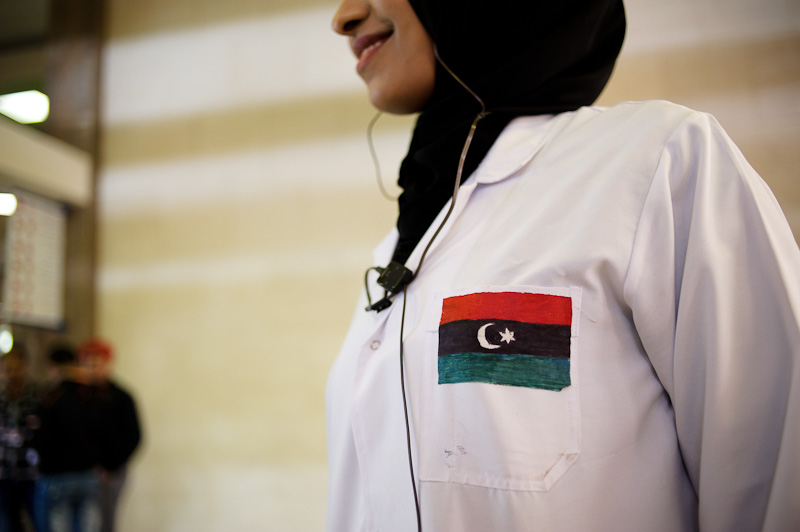
The flag of the revolution is everywhere.

Libyan nurse at the Benghazi Medical Centre.

The flag of the revolution is everywhere.

Libyan nurse at the Benghazi Medical Centre.

Hearts & Minds

When I crossed into Libya, the rebels manning the border were happy to see foreign journalists coming into the country. The armed men at the checkpoints would smile and give a “V for victory” salute as our car drove through their barricades, en-route to Benghazi.

Around the city, graffiti would thank Al-Jazeera, CNN, the BBC. Television screens had brought the plight of those in Benghazi to the world stage, as well as having offered inspiration from their coverage of the Tunisian and Egyptian revolutions.

The rebels liked journalists.

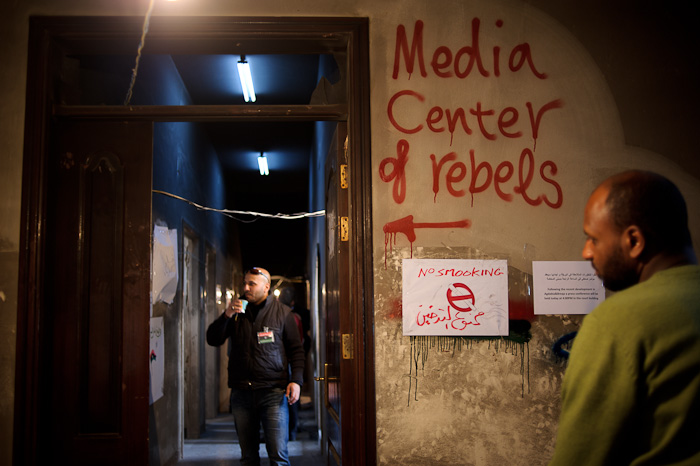
In a burned out building on Benghazi’s corniche, over-looking the Mediterranean, a set of offices had been cleaned out and dedicated to the new national, and foreign, press. The “Media Centre of Rebels”.

They issued Heath-Robinson press cards, bearing the tricolour of the Sanussi-era flag. And more importantly, they could arrange drivers and translators. A willing little army of young, educated, English- and French-speaking volunteers was keen to get their first taste of The Press.

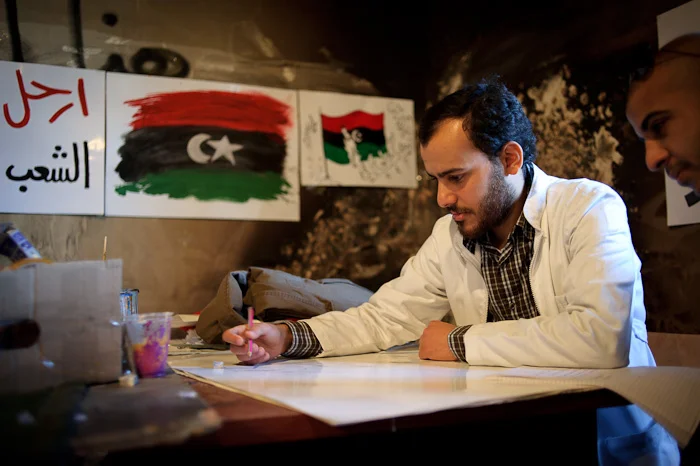
There was also another army of volunteers, surrounded by slogans in both Arabic and in English, claiming an end to Qaddafi’s rule, cataloguing his errors and his crimes. The building was filled with caricatures, political slogans and “fact-boxes”. Some of these posters and placards would later be out in the street, protesting against Qaddafi, and raising the morale of the Benghazians. And of course, splashed across the pages of the international press.

Caught in a war-zone

I had already met with thousands of migrant workers fleeing Libya at the Egyptian border. Depending on your viewpoint, they were the lucky ones.

Lucky in that they were out of the conflict. Unlucky because, stranded at the border, the humanitarian situation was rather dire. Many had no shelter, little food nor sanitation, and knew not when they could return home.

At the port in Benghazi, the Libyan Red Crescent was incredibly organised, providing hot meals for over one thousand migrants now camped there. The port authorities had vacated their offices, which had turned into dormitories for the foreigners stuck there. People would arrive with donations of food and blankets.

Many spoke of wanting to leave for the border, but were unaware of the situation that awaited them there, and feared the journey out of Benghazi. The majority were not “hardened refugees”, but migrant workers having been brought here by recruitment agencies, promising the chance of a job with which they could send money home.

“I haven’t been paid for four months” said one Bangladeshi man, clutching a photo-copy of his passport - the original still in his employer’s office in Tripoli. “My boss just left the country”, fleeing the conflict.

With little information on the situation in the country, nor what would happen to them, many preferred to stay put in the camp at the port. They didn’t know that the cracks of gunfire that could be heard around the city were celebratory, and not the sign of a nearing battle. Instead, they spend their days gazing out of the harbour, hoping that another ship would arrive, and take them to safety.