Sandstorm at the border

Chadian men walk through a sandstorm that engulfed the region around the Egyptian border near Sallum on March 31, where an estimated 2500 people are still stranded, having fled the Libyan revolution. Many of those at the border are sleeping outside …

Chadian men walk through a sandstorm that engulfed the region around the Egyptian border near Sallum on March 31, where an estimated 2500 people are still stranded, having fled the Libyan revolution. Many of those at the border are sleeping outside under blankets and make-shift shelters, the Egyptian authorities refusing to allow even any semi-permanent structures, such as tents.

For me, this would be my final day working at the border. This last trip would cost me my left eye for a few days. An infection would seal it shut for a week. But I had an out. A comfortable bed in Khartoum, and then Cairo. Clean water and time for repose. For the thousands stranded at the border, right now, there is no end in sight. And no sign of an end to the fighting raging in Libya.

Lost in the Fight

Eight-year old Saad spent eleven days separated from his family as intense fighting erupted around Ajdabiya in eastern Libya. Now reunited, he is celebrating the town’s “liberation” from pro-Gaddafi troops with his brother Senat, how also went missing during the fighting.

On the main roundabout in Ajdabiya, cars circle with Senussi era flags—now the symbol of Libya’s revolution—hanging out of the window. Pro-revolution graffiti covers the walls, but signs of the recent fighting are everywhere. The graffiti is pockmarked by bullets, shell holes crater the roads, and bullet cases and empty ammunition boxes litter the pavement. All just metres from where Saad and his brother are celebrating.

A few kilometres outside of the freshly liberated town, people gather around the shells of several tanks, seemingly destroyed by Nato airstrikes as they advanced east.

Living under shells

Living under shells

Four year old Mohamed hides behind the door of his home. He is nervous, and has had many sleepless nights recently. Unlike the families who fled to the desert, Mohamed’s family decided to stay in Ajdabiya during the fierce…

Living under shells

Four year old Mohamed hides behind the door of his home. He is nervous, and has had many sleepless nights recently. Unlike the families who fled to the desert, Mohamed’s family decided to stay in Ajdabiya during the fierce fighting that erupted between Qaddafi loyalists and rebel fighters.

“There was firing everywhere, my family was terrified” says Abdil Gadir, Mohamed’s father. A few nights ago, two shells hit their home. “It just went boom, boom, boom” he says, talking of that night. At 11pm, his home was rocked as a shell pierced the roof of the family’s bathroom.

Ajdabiya was retaken by rebels yesterday, but the city is now without electricity or water. The local hospital has been evacuated and is all but closed, and rebels continue to man the checkpoint of the western gate to the city, fearful of returning troops. The front-line in this stretch of the Libyan desert is in constant flux, with fighting regularly breaking out in both Ajdabiya and nearby Brega.

Far from Victory

Far from Victory

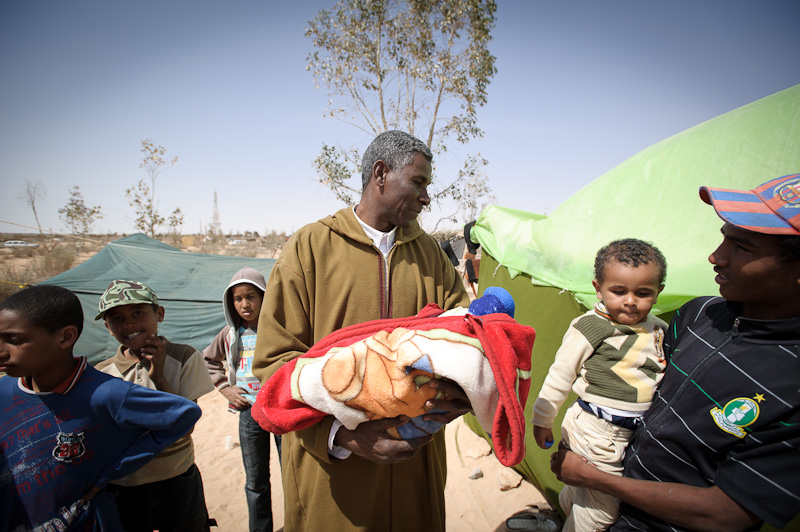
In a sprawling camp in the Libyan desert, Mohamed Othman stands outside his makeshift tent, cradling his daughter Entisah. Meaning “Victory” in Arabic, Entisah was born in this tent just two days previously, as shells r…

Far from Victory

In a sprawling camp in the Libyan desert, Mohamed Othman stands outside his makeshift tent, cradling his daughter Entisah. Meaning “Victory” in Arabic, Entisah was born in this tent just two days previously, as shells rained down on Ajdabiya, her family’s home until a few days ago.

Thousands have fled Ajdabiya in the past two weeks, many ending up here, on the side of the Tobruk - Ajdabiya highway, twenty-five kilometres away from the shell-marked town.

“We are all Bedouin here”, says Mohamed, talking about their ability to adapt to leaving the bricks and mortar of their houses, replacing them with the wood from the trees that used to be the sole inhabitants of this land.

With no access to the hospital, Entisah was born in the desert using traditional methods, “with help from the old ladies”.

“It is a situation we were brought into” says Mohamed, describing the conflict that consumed his town.

Ajdabiya was re-taken by rebels yesterday, forcing the Qaddafi troops back towards Brega. But the situation is still evolving rapidly, and with the troops so close to the town, many here are reluctant to leave just yet.

Khalid, a nineteen year old also staying here in the camp, came ten days ago. “It is very cold here at night” he says, “we all need water, tents and food”.

Speaking of his daughter’s future, Mohamed says “I hope she will live a better life than before”, and he hopes to be able to return to his home soon.

Outpost

Traveling back into Libya. An armed soldier mans the Tobruk - Ajdabiya desert highway.

Yesterday, Ajdabiya was re-taken from Qaddafi loyalists by rebel fighters. I couldn’t help but remember that this was the same road where a good friend of …

Traveling back into Libya. An armed soldier mans the Tobruk - Ajdabiya desert highway.

Yesterday, Ajdabiya was re-taken from Qaddafi loyalists by rebel fighters. I couldn’t help but remember that this was the same road where a good friend of mine was kidnapped by the loyalists just a week previously.