Blame it on the Elections

During my time in the West Bank, whenever something bad happened, those around me retorted with “blame it on the IDF”. Be it a wait at a check-point, hassle in the street, or even dropping a glass, everything w…

Blame it on the Elections

During my time in the West Bank, whenever something bad happened, those around me retorted with “blame it on the IDF”. Be it a wait at a check-point, hassle in the street, or even dropping a glass, everything was their fault.

Now in Khartoum, the same rhetoric is being used as Sudan begins its path to democracy. “Blame it on the elections” is said as a catch-all excuse; my delays in leaving, problems in transport, and more pertinently today for the Nuba Wrestling.

Along with the Sufi dancing in Omdurman, the traditional wrestling originating from the Nuba mountains is one of the things to see in Khartoum. The wrestling normally takes place every Friday at Souq Seta in Khartoum’s Bahri district, but arriving the day after the polls officially closed, the market-holders told us that it was closed, due to the elections. General feeling is that the government is keen to avoid large gatherings of people. We took the opportunity to gather mangoes, instead; they’re in season now, and delicious.

Days of Tea

I had time to kill in Khartoum, and so took to the streets. Ostensibly, it was the election prolongation that was keeping me here, but in reality there were a few more factors. An increasing interest in the country, particularly at this time in Sudan’s history; a growing social group of people whose company I valued; perhaps also the need to take a little repose from traveling.

Khartoum is perhaps a strange place to do this. There is very little in terms of things to “do”, particularly as a new arrival; I had already visited the two main museums, the National museum and Ethnographic museum. There are no cafés boasting taawila as in Cairo, nor the Egyptian capital’s bustling cultural scene. Khartoum is a long way from Damascus’ architectural grace and Jerusalem’s historical significance. Furthermore, the climate is incredibly oppressive — daytime temperatures stay above 40°, the streets are dusty and walking them is an arduous affair.

Yet this is what I did. I walked across the city to the soundtrack of shouts of khawaaja (the affectionate, Sudanese equivalent of mzungu or “foreigner”). Life in Sudan is lethargic, with many people seemingly just sitting around or snoozing, taking shelter from the sun.

I stopped frequently to take jebbaneh — coffee spiced with ginger — or a shai bil-nana — tea with a little mint. Whilst there is a lack of cafés, there is certainly a plenitude of tea-ladies plying their trade, and this is the place to meet people. The Sudanese are incredibly friendly and keen to speak to khawaaja about their country, for which they often feel great pride, and find out what the said khawaaja thinks about it. At times frustrating, being asked for the umpteenth time about the difficulty of the heat, but often enlightening, discovering more about this confused country’s culture.

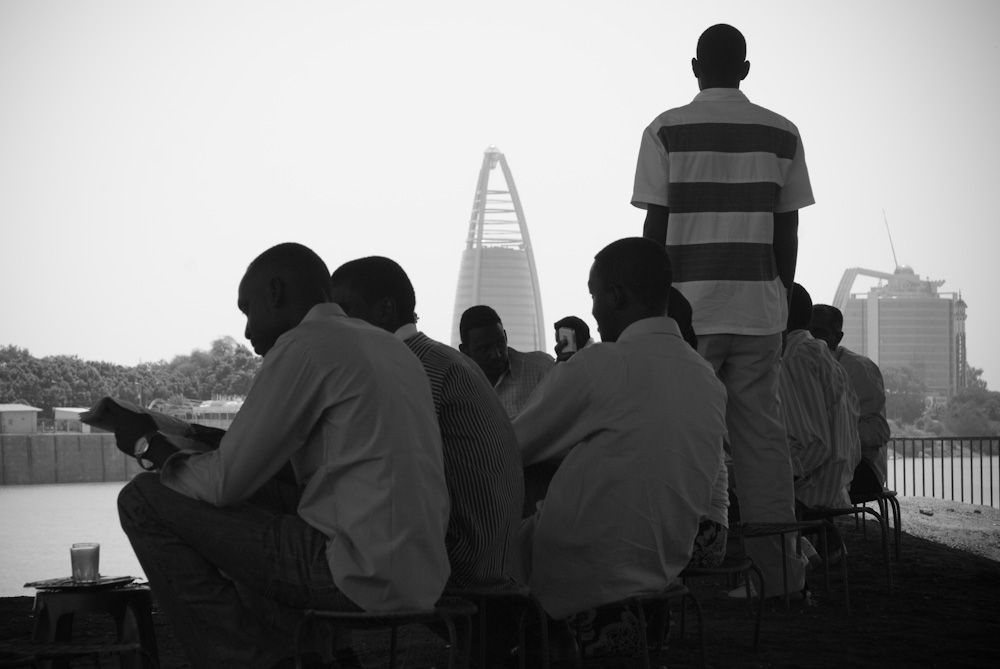
Admittedly, language often limited conversation; my Arabic is far from capable of holding a meaningful conversation and in many of the places I took refreshment, English was not in abundance. A half-built building opposite the University of Sudan changed this situation. In its concrete shell seemed to exist an impromptu Students’ Union, full of people sat around on small, rope-twined stools surrounding tea-ladies.

The students here were keen to discuss Sudan. Some were waiting for the first opportunity to emigrate and make their life in Europe, others had aspirations to develop the country and make change here in Sudan. Some felt exasperated at the limited opportunities they have, explaining that without being a member of the ruling National Congress Party, jobs are hard to find; Western countries are less than forthcoming with visas for Sudanese nationals. Ahove all, this trip has made me realise—and cherish—the value of my passport, and the luck I had in the nationality lottery…

Elections Prolonged

The voting period for the elections was due to end today, the 13th April, but due to various problems, has been extended by two days.

Problems delivering ballots in the south meant that the National Electoral Commission (NEC) d…

Elections Prolonged

The voting period for the elections was due to end today, the 13th April, but due to various problems, has been extended by two days.

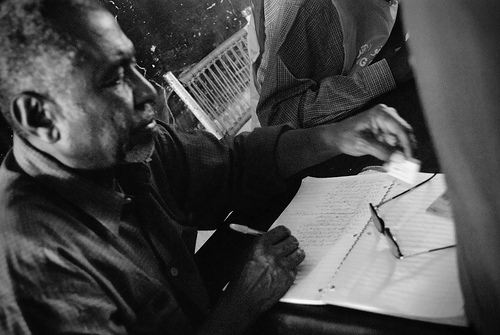
Problems delivering ballots in the south meant that the National Electoral Commission (NEC) decided to “compensate the lost time” by prolonging the voting period, although in some areas, they will freeze the elections because of “logistical issues”. There have been also problems of voter registration, and the lengthy process of locating voters’ names on the electoral lists (photo, above) has also caused large queues at polling stations.

The Sudanese People’s Liberation Movement (SPLM), the ruling party in the South, has called for an extension of four days, although some believe, particularly in the North, that those who intend to vote have done so already. Omer Mahmoud, a BBC correspondent in Khartoum, describes the voting mood in the capital as “lacklustre”, and quotes the head of one polling centre in Bahri saying that 85% people had cast their vote, most on the first two days.

In Darfur, James Copnall, the BBC correspondent for Sudan, finishes his piece on voting in Darfur by saying:

But the people most opposed to President Omar al-Bashir are the least likely to have voted.

— James Copnall, BBC Sudan correspondent

An extension to the voting period means a longer delay in the announcement of the results. Counting will commence on Friday, with final results scheduled for next Tuesday, the 20th April. This seems rather optimistic.

It looks like my stay in Khartoum, and Sudan, will be somewhat longer than expected…

» More photos: Sudanese Elections.

Sudanese Elections 2010

Many in Khartoum were waiting with baited breath as polls opened on the 11th April. The rhetoric here has been simply that “nobody knows what will happen”. My Eritrean housemates, already timid walking the street…

Sudanese Elections 2010

Many in Khartoum were waiting with baited breath as polls opened on the 11th April. The rhetoric here has been simply that “nobody knows what will happen”. My Eritrean housemates, already timid walking the street in Sudan, fear leaving the house. Would there be demonstrations, civil unrest, police crackdowns? The answer seems to be in the negative.

On the streets of downtown, it seems like any other day. There is a slight increase in police presence; local newspapers report that in some regions elsewhere in Sudan they are more prevalent. “We’re not expecting widespread violence, only things that might blow up in pockets”, Reuters quoted an aid-official.

The major problems that are reported in local newspapers are those concerning voter registration. Months ago, eligible voters had to register with their local voting centre, sometimes causing complications for those living in other parts of the country than their home-town. For over two million Darfuris living in IDP camps, they will have no voice in the process. Now the polls have opened, there have been widespread reports of people arriving at their nominated polling station to find their names missing from the list of voters. Many people do not have the means to travel to neighbouring stations to search for their names. Even at the right station, finding one’s name can be a long process, causing queues, and further complicated by spelling errors.

In the South, particularly, voting was widely delayed by several hours due to problems in the logistics of delivering materials and ballot papers. Once arrived, further complaints were lodged due to mis-printing or omissions of candidates’ names. Changes of party logos on the ballot papers also posed another problem. In a country where illiteracy rates are estimated at 30% - 40% (a recent statement by the Ministry of Education put the figure at 14 million, from a population of around 42 million), identifying a logo—rather than a candidate or party name—is crucial to a significant portion of the populace.

A whole generation has never voted and the process is complex: people in the north will vote eight times, in the south the figure rises to twelve. Salva Kiir, the president of South Sudan and voting for the first time in his life, spoiled his first ballot by depositing it in the wrong box.

I have met mixed reactions in Khartoum. When asked why certain of my friends don’t have a green, ink-stained finger (signifying having voted) some reply that they don’t care, some that they are not registered. Others, though, are incredibly happy — and proud — to have participated in elections that are heralded to bring democracy to the country. As I visited a voting station in Khartoum, a woman proudly showed her ink-stained finger and a man was keen to show that there were no problems with the process, evidently expecting this western observer to expect the worst.

“These elections will not suddenly transform Sudan into a democratic society. That will take time and experience.”

— Abdallah Ahmed Abdallah, a top official at Sudan’s electoral commission

» More photos: Sudanese Elections.

Sudanese Elections Run-up

Sudan, 1989: General Omar Hasan Ahmad al-Bashir leads a military coup, ousting the civilian regime, suspending political parties and naming himself Chief of State, Prime Minister, Chief of the Armed Forces and Minister of Defence. Four years later, he appoints himself President and disbands rival political parties.

In 1996, President Bashir transformed the country into an Islamic totalitarian single-party state, and in the national election of that year, he was the only candidate to run. Attempts to reduce the President’s power before the 2000 election resulted in Bashir dissolving parliament and declaring a state of emergency. Opposition parties boycotted these elections.

Come 2005, civil war was officially ended in Sudan with the signing of the Comprehensive Peace Agreement (CPA), and the creation of a co-Vice President, representing the South, formed part of the new Government of National Unity.

Now, in April 2010, Sudan is preparing itself for what are heralded as the “first genuine multi-party poll in the country since 1986”. Ahead of the southern secession referendum, scheduled for January 2011, the elections are seen as a test of the country’s democratic ability. Al-Bashir, who’s victory is widely quoted as “assured”, is also aiming to legitimise his presidency following last year’s indictment by the International Criminal Court, facing charges for seven counts of war crimes and crimes against humanity.

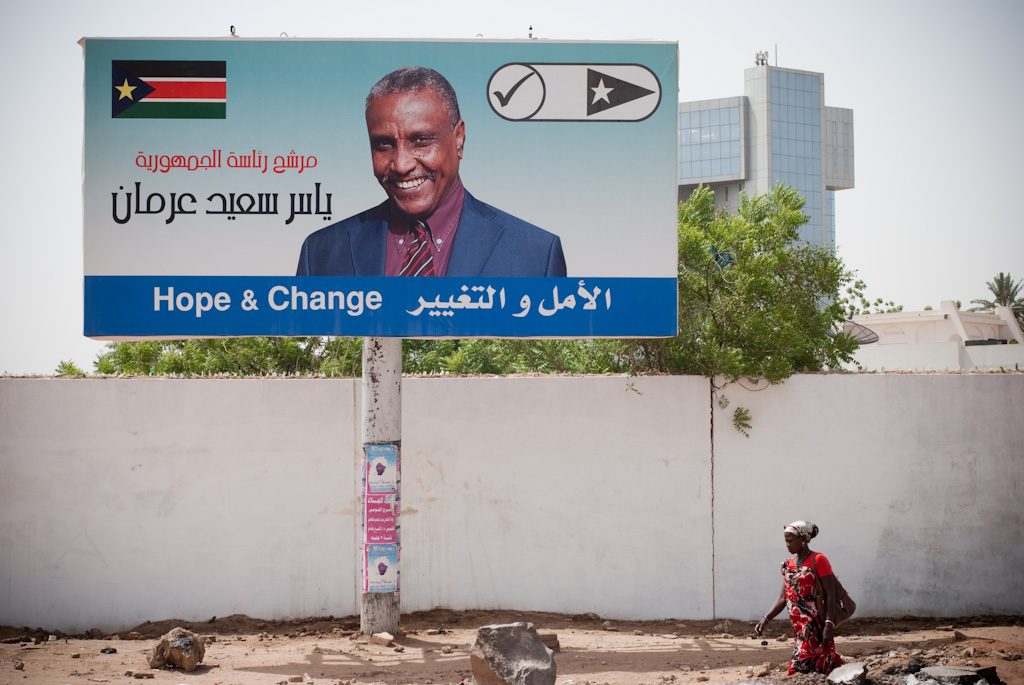
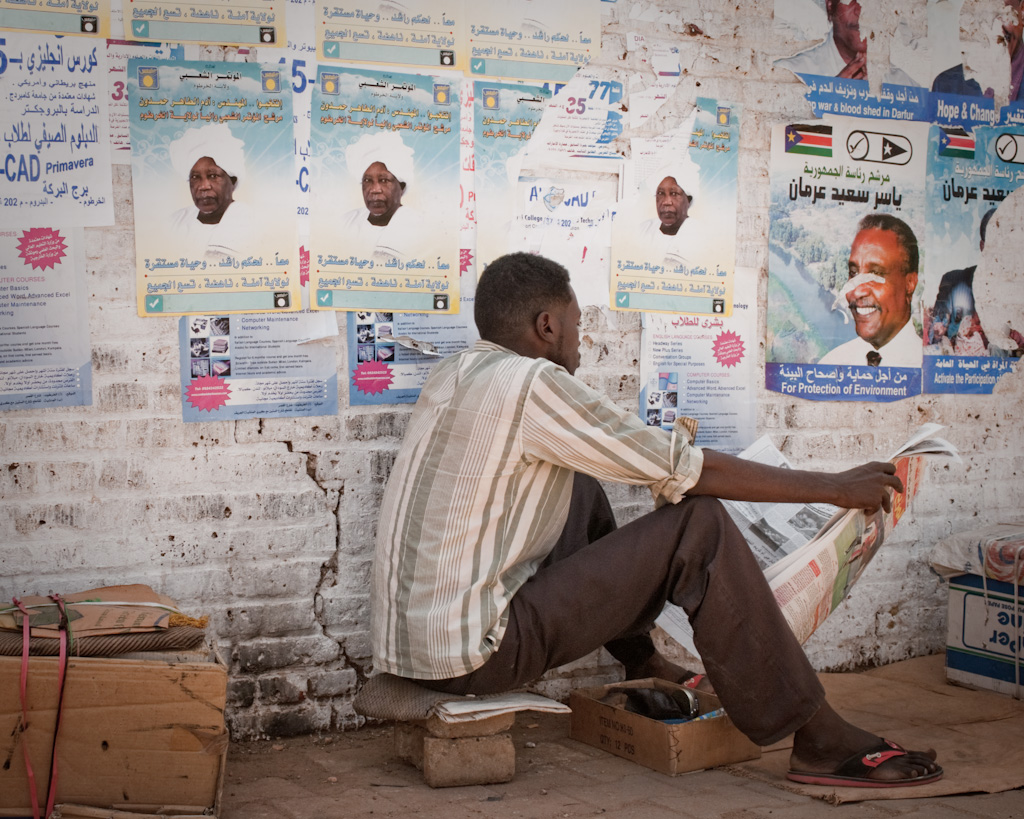
Walking the streets of Khartoum, political posters line every street. Amongst these, there is a marked difference in the means available to garner votes; traveling down from the northern border to Khartoum, the route is lined by giant billboards showing al-Bashir against a backdrop of new roads, bridges and dams, projects instigated under his National Congress Party’s (NCP) rule. Apart from the odd billboard for the Sudanese People’s Liberation Movement (SPLM), the ruling party in the South, opposition posters are somewhat marginalised, furtively pasted to walls, torn at the edges.

The elections are already mired by condemnations from both international observers and opposition parties. Human-Rights Watch alleges repression of opponents of the NCP, as well as media restrictions, claiming it threatens the prospect of a “free, fair and credible vote”. Darfur is still torn by conflict, the International Crisis Group (ICG) saying many displaced Darfuris will be denied the right to cast their vote. Around 2.6 million people live in displaced persons’ camps. Despite this, the National Electoral Commission says that 81% of eligible voters have been registered. Yet the ICG claims that the NCP has “has manipulated the census results and voter registration, drafted the election laws in its favour, gerrymandered electoral districts, co-opted traditional leaders and bought tribal loyalties”.

The European Union has withdrawn its election observers from Darfur, citing safety concerns. Some foreign election observers have recommended a postponement of the vote in order to resolve the issues of fraud, logistics and security, resulting in a fiery condemnation from the President.

Any foreigner or organisation that demands the delay of elections will be expelled sooner rather than later … We want them to observe the elections, but if they interfere in our affairs and demand the delay, we will cut off their fingers and put them under our shoes and expel them.

— Omar al-Bashir, Sudan’s incumbent president

The problems have contributed to stories emerging of many opposition parties boycotting the elections. Conflicting stories of party boycotts have appeared in both the national and international press, leading to confusion amongst voters. Here in Khartoum, I have read articles in the same newspaper providing contradictory information. The international media says that Yasir Arman of the SPLM has withdrawn from the presidential race citing alleged fraud and the instability in Western Darfur; he was expected to provide the greatest challenge to the Bashir’s presidency in the North. The SPLM itself is withdrawing from several northern states. The northern Umma party is said to have withdrawn from the poll completely.

Whilst the international media talks of the wide-spread opposition to Bashir, here in the north, many people say they will vote for him. Several people I spoke to in Karima said that whilst they believed he & the NCP have many problems — corruption and the violence in Darfur, for example — they think he is the strongest candidate to lead the country. “He has so much more experience than the others.” Others believe the boycott by candidates exemplifies their lack of qualities for president. Disillusion also plays its part, the BBC quotes a first-time voter as saying “I don’t have any options, because all the people I could have voted for have withdrawn, they are cowards!”

The Sudanese also face confusion about the logistics involved during the three days of polling which begin on April 11. Many are unsure if there will be a national holiday and if public transport, vital for some to reach polling stations, will be operating. Bus tickets out of Khartoum have seen a price increase, preventing some from making the journey home to where they are registered.

All of this comes before a single vote has been cast. Talking with other internationals here, uncertainty is the word on everybody’s lips. This is the first time in over two decades that such an event has taken place, and nobody knows how it will pan out. The UK Foreign Office website warns “as a precaution in case of any rallies or demonstrations which might inhibit movement, you are advised to maintain several days’ stock of food and water”. Me, I’ll be staying in Khartoum for a few days longer…

» More photos: 2010 Sudanese elections.