It was with a lot of trepidation that we drove back down to Ras Lanuf this morning. I was hitching a ride with an agency photographer, and there was some debate about whether we could cross through the rebel checkpoint around fifty kilometres east of Ras Lanuf.
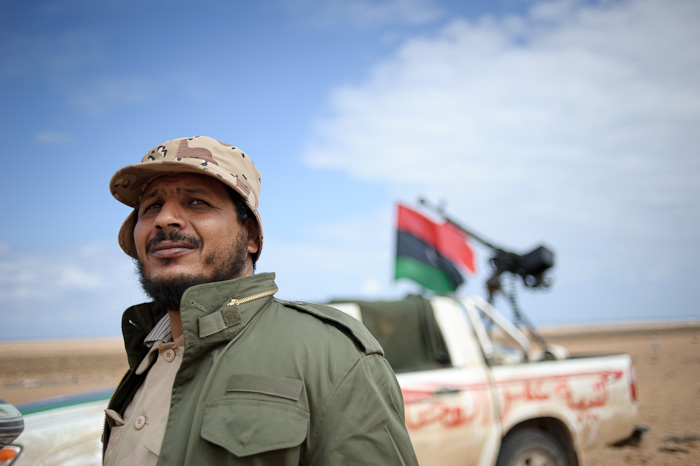
The rebels’ technicals were racing past us in the opposite direction, and nobody was sure of what lay ahead. Yesterday’s bombings were still very fresh in my mind.
After much debate and coercion, we arrived back at the checkpoint where I had spent the previous day. There seemed much fewer rebels on the ground, with fighting at the front-line several kilometres beyond this position.
“You have to wait for the general” we were told when trying to advance further. In this rag-tag group of fighters, the idea of such a formal commander seemed a world away.
When a jet was heard overhead, my heart was in my mouth. I tried to rationalise the situation, and whichever way I did it, things looked worse.
Perhaps the loyalist pilots intended to miss us yesterday. They didn’t want to kill their countrymen, they just wanted to scare them. Today they would be forced to bomb closer. Less than one hundred metres separated me from the explosions yesterday, and I wasn’t keen to experience it more intimately.
Or perhaps it was just poor targeting. These were dumb bombs, after all, dropped from great altitude and at very high speeds. Yesterday was rather windy, maybe they just missed. Well today there was little wind.
I was keen to advance from this target. And besides, I couldn’t get any different images to what I got yesterday.
Eventually, the mysterious general arrived, and we could advance, away from the bombs. Perhaps.
On the desert highway just before Bin Jawad & Es Sidr, a mass of rebel pick-ups was assembled on the dune to our right. Regular, incoming shelling could be seen in the distance. A man stood with his back to it all, his boots between his legs as he prayed.
Our car could go no further. I clambered up the sandy hill to a group of rebels having what seemed to be a picnic. As they sat around eating sandwiches, the Mediterranean lapped the shore just behind them to the north.
But to the west, columns of sand and smoke were rising. Cracks of gunfire would ring out from the rebels below us. We seemed to be out of range of the Qaddafi shells but we were well aware that the loyalist troops’ weapons had a greater range than those of the rebels.
Suddenly, the rebels started firing volleys of their grad rockets towards the Qaddafi position. Rocket after rocket would rip into the sky, the sound of the first stopping my heart.
As I grasped the situation, I moved towards them, trying to capture the intensity of what was happening, whilst also trying to comprehend that I was in the middle of covering a conflict.
And then the incoming shells started ripping up the desert right at the bottom of this dune. Perhaps we weren’t quite as out of range as I believed.
Our driver called out saying he was leaving, and my colleague was in no mood to argue. As I ran down the hill towards the road, a shell zipped over my head, exploding to my left right on our escape route.
My heart was pounding as I sprinted, holding my two cameras and leaping over ditches. For a brief second, my mind was back in the French Alps, trail-running down the mountains of Haute Savoie.
As the car started moving, I dived into the rear seat. His foot to the floor, our driver weaved through the rebels who also fled. It was carnage, perhaps the most danger came from being bumper to bumper with these panicked, erratic fighters as we all vied to escape.
Parked at Ras Lanuf, I walked back towards the front-line along with a group of rebels. Huge, black columns of smoke rose from the oil-depots there as a jet flew over us. Again, the thundering rounds from the guns ripped into the sky. Again, the jet flew on, unhindered.